
DocIntel case study by Victor Omolasoye, Product Design, Strategy & AI-assisted Development —
AI document intelligence for invoices and receipts
A product design and AI case study
Product Design, Strategy & AI-assisted Development
2026
Project overview
Businesses process large volumes of documents every day. Invoices, receipts and other financial records contain valuable information, but extracting that information and organising it into usable formats is repetitive, time-consuming and prone to human error.
DocIntel is an AI-powered document processing platform designed to simplify that process. It transforms unstructured business documents into structured, organised data that users can review, validate and export. Rather than manually transferring information from documents into spreadsheets, users upload their files and let AI handle the initial extraction.
The goal is simple: reduce repetitive administrative work and make business information easier to access, manage and use.
6
Workflow stages
Upload through to export
2
Export formats
Structured CSV and Excel
1
V1 focus
Invoices and receipts
MVP
Current stage
In active development
The problem
For accountants, finance teams and business operators, document processing involves more than simply reading a document.
A typical workflow asks someone to
- Open individual invoices or receipts.
- Identify important information such as vendor names, dates, totals and tax amounts.
- Manually transfer the information into spreadsheets or accounting systems.
- Check entries for missing or inconsistent information.
- Organise records for reporting and future reference.
When this process involves dozens or hundreds of documents, the workload increases significantly.
The real problem
The information is not unavailable. It is trapped inside documents and requires manual effort to become useful.
The opportunity
I saw an opportunity to create a tool that bridges the gap between documents and structured business data. Instead of building another document storage platform, I wanted DocIntel to help users move from raw files to usable information through one connected workflow.
The product needed to do more than extract text. It needed to understand document content, organise extracted information, identify uncertainties, and give users control over the final output.
Product goals
The initial product direction focused on five objectives.
- 1Simplify document intake: make uploading individual documents and processing batches straightforward.
- 2Automate data extraction: use AI to identify and extract relevant information.
- 3Improve data reliability: validate extracted fields and highlight missing or uncertain information.
- 4Keep users in control: allow users to review, correct and approve extracted data.
- 5Make data reusable: enable users to export structured information into formats such as CSV and Excel.
The core workflow
I approached the experience as a connected process rather than a collection of independent features.
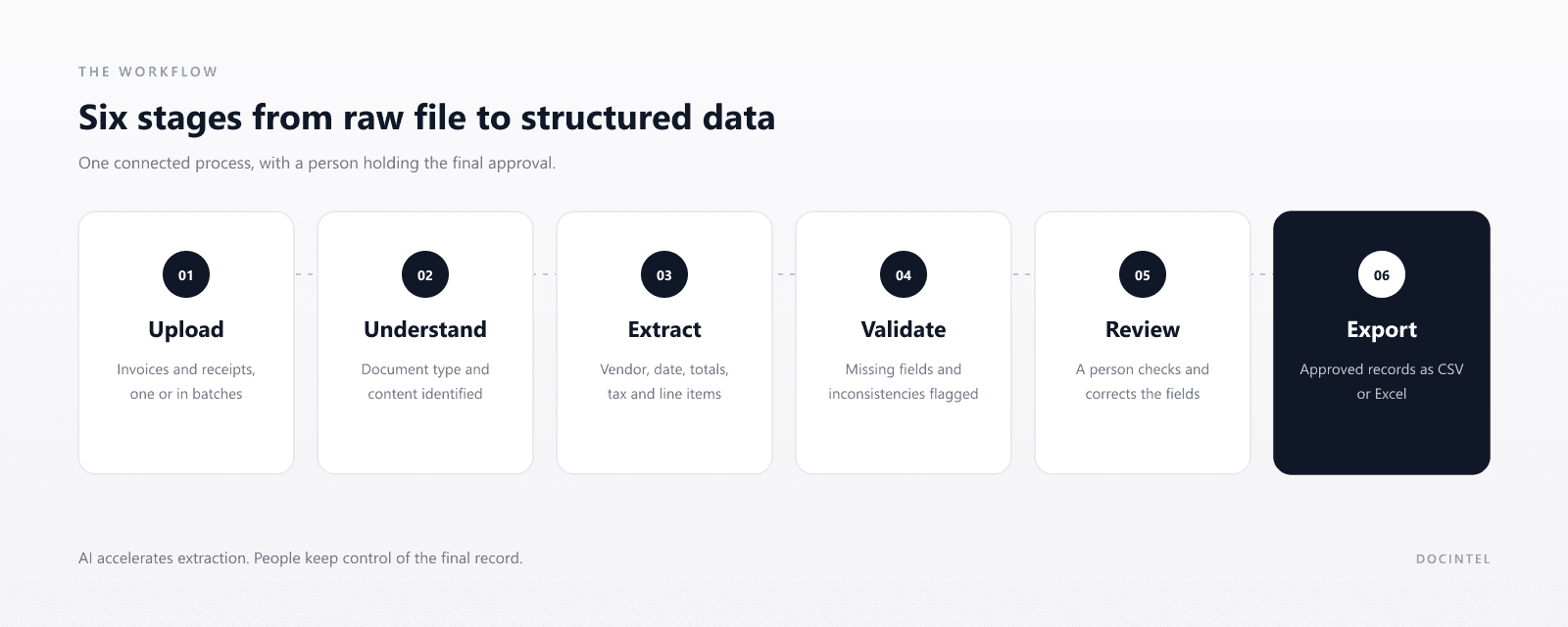
01
Upload
Users upload invoices and receipts individually or in batches.
02
Document understanding
The system processes the files and identifies the relevant document type and information.
03
Data extraction
AI extracts key information such as document number, vendor, date, subtotal, tax and total amount.
04
Validation
Extracted information is checked for missing fields, inconsistencies and uncertainty.
05
Human review
Users inspect the original document alongside the extracted information, make corrections and approve the results.
06
Export
Approved information is exported into structured CSV or Excel files.
Design decision
Keep human review within the workflow. AI can accelerate extraction, but users should retain control over the accuracy of their business records.
Designing the experience
The interface is organised around the work people actually do: bringing documents in, understanding their status, reviewing what the AI found, and getting clean data out.
A focused workspace
The product is designed around a dashboard that gives users a central place to manage document processing. The experience prioritises clarity and functionality, helping users understand what needs attention, what is being processed and what has been completed.
Document processing
Uploading documents should feel straightforward, whether users are processing one invoice or a large batch. The interface communicates processing progress and understandable statuses without exposing unnecessary technical details.
Extraction review
Rather than presenting extracted information as automatically correct, the interface lets users compare the original document with the extracted fields. They can identify missing information, correct mistakes and approve the final data before exporting.
Organisation and export
Extracted information needs to remain useful beyond the initial processing stage. DocIntel helps users organise processed records, revisit previous documents and export approved information for use in their existing workflows.
Designing for trust
Automation is only valuable when users can trust the information it produces. For this reason, reliability and transparency are important considerations in DocIntel's product direction.
The experience is designed around a few principles
- Never invent information that is missing from a document.
- Make uncertain or incomplete fields visible.
- Allow users to correct extracted information.
- Preserve the relationship between extracted data and its original document.
- Protect business documents and keep account data isolated.
Positioning
DocIntel is a document intelligence tool, not an uncontrolled AI text generator.
Product architecture
DocIntel is being developed as a web-based SaaS application. The current technical direction is deliberately small, focused on the pieces the first version needs.
Current technical direction
- Next.js and TypeScript for application architecture and frontend development.
- Supabase for authentication, database, file storage and backend services.
- AI processing for document understanding and structured information extraction.
- CSV and Excel export for structured, reusable data.
The architecture is intended to support additional document types through dedicated extraction schemas and validation rules, without making the initial experience unnecessarily complex.
Challenges and considerations
Building DocIntel involves more than connecting an AI model to a file upload interface.
Extraction accuracy
AI can misinterpret information, especially when documents have inconsistent layouts or poor image quality. The product needs validation and human review rather than assuming every extraction is correct.
Data privacy
Business documents can contain confidential financial information. Authentication, access control, storage permissions and account-level data isolation are essential.
Workflow continuity
Users should be able to return to their workspace and access their original documents and processing history across sessions and devices.
Product abstraction
The technical complexity behind AI processing should not become the user's responsibility. The experience should communicate clear, familiar statuses rather than exposing model names, API providers or backend configuration.
What's next
The initial focus is on invoice and receipt processing. The broader product vision extends beyond financial documents.
Potential future capabilities
- Contract information extraction and analysis.
- Structured information extraction from identification documents.
- Accounting and business software integrations.
- Automated financial summaries and reporting.
These extensions will build on the same core idea: turning unstructured documents into information that businesses can actually use.
Final thoughts
DocIntel explores a simple but important idea: businesses should not have to spend so much time manually moving information from one document to another.
By combining AI-powered extraction, validation and human review, the product aims to make document processing more efficient without sacrificing user control.
For me, this project is also an exploration of how AI can be applied to practical business problems, moving beyond generating content to building useful tools that simplify real workflows.
DocIntel
From documents to intelligence.