Moovable case study by Victor Omolasoye, Product Designer & Product Owner —
A connected logistics operating system for Africa
A product design and product ownership case study
Product Designer & Product Owner
2026
Project overview
Moovable is a connected logistics operating system for the people who move goods across Africa. I contributed to the design of a product ecosystem that connects businesses, logistics operators and administrators through role-based workflows, replacing fragmented WhatsApp coordination with shared operational records.
The work spans three web portals. Each experience is tailored to a particular operational context, with a shared product language connecting the workflows that cross roles. My challenge was to translate the operational reality into a product structure that would be understandable to each participant, while supporting more complex requirements such as bulk shipments, fleet operations, geographical coverage, pricing and financial workflows.
450+
Major screens and modals
Designed across multi-module portals
3
Connected portals
Business, Operator and Admin
6
Developers
Collaborating on the product
Jan 2026
Started
Ongoing product work
Context & problem
Moving goods reliably requires several independent actors to coordinate the same delivery, often across different locations, devices and levels of operational responsibility.
At Moovable, the starting point was existing logistics activity coordinated through WhatsApp and other manual processes. Shipment details, rider communication, dispatch decisions and tracking updates lived across conversations. This made a shared understanding of each delivery difficult to maintain as activity grew.
Coordination
Shipment requests, rider updates and dispatch instructions can be spread across conversations, creating a need for centralised operational records.
Visibility
Businesses need shipment visibility. Operators need fleet and dispatch control. Administrators need platform oversight. Each role needs a different view of the same delivery.
Scale
High-volume deliveries, region boundaries, hub coverage, pricing and integrations require structured workflows that can support more than a single shipment.
The design problem
How might a logistics platform make every delivery understandable to every role involved, without flattening the different responsibilities each role carries?
The product solution
One system. Three connected experiences. Each portal is tailored to its role while sharing one operational record.
Business Portal
Businesses create individual or bulk shipments, review delivery requirements and track progress without calling the driver. The portal holds shipment creation, tracking and delivery history in one place.
Operator Portal
Operators manage fleet availability, coverage, dispatch and delivery operations. The portal supports the coordination work that keeps shipments moving and makes responsibilities visible across the team.
Admin Portal
Administrators oversee platform activity, operational controls and configuration. The portal brings platform-level decisions and oversight into a structured environment.
Shared product language
The portals share components, interaction patterns and terminology, so a workflow that starts in one role and continues in another still feels like one product.
How the experience comes together
A high-level view of the delivery journey and the responsibilities the product supports.
01
Create
A business prepares shipment details, individually or in bulk, and submits the delivery requirements.
02
Coordinate
Operators manage coverage, fleet availability and dispatch decisions against the request.
03
Deliver
Riders handle the delivery while operational updates keep each participant informed.
04
Track & reconcile
Teams review progress, delivery records and financial activity after the delivery is complete.
My involvement
My role combines product design with Product Owner responsibilities as part of the team. I work across the product lifecycle, translating operational requirements into usable experiences and contributing to decisions about what to build.
Since joining in January 2026, I have designed 450+ major screens and modals across multi-module portals and role-based workflows. I also extend an existing design system, maintain reusable components and collaborate with a six-person development team to turn designs into implemented product behaviour.
Product Designer
Translate operational research into user flows, information architecture and interfaces. Design responsive and role-specific workflows across the portals. Explore complex geospatial interactions through independent research. Extend the design system, component library and interaction patterns. Document designs and review implementation fidelity before formal QA.
Product Owner
Interpret requirements with stakeholders and clarify expected feature behaviour. Contribute to feature prioritisation and product roadmap conversations. Work with developers on user flows, specifications and implementation decisions. Participate in sprint planning, product demonstrations and feature reviews. Help make release decisions and request corrections when implementation diverges from agreed designs.
Approach & design process
A logistics operating system requires continual work across research, interaction design, requirements and engineering. My approach connects those activities so the design can evolve alongside the product.
- 1Understand the operational reality: study how shipments, rider communication, dispatch and fleet activities were coordinated, including WhatsApp-based processes. Identify where a digital workflow can create clearer responsibilities and visibility.
- 2Define the workflows and roles: translate operational activities into centralised user flows across the Business, Operator and Admin portals. Map which role needs to act, which information supports that action, and how work passes between participants.
- 3Design and maintain consistency: develop the screens and modals required for each module, extend the existing design system, and reuse established components and interaction patterns as the scope expands.
- 4Collaborate on implementation: agree on feature behaviour with the development team, interpret requirements and document designs. Sprint planning, product demonstrations and feature reviews create opportunities to resolve questions before release.
- 5Review, validate and improve: review implemented interfaces and functionality against approved designs before formal QA. Raise discrepancies for correction and incorporate feedback from early organisational testing into subsequent design decisions.
Design decisions & product detail
Beyond the main delivery journey, I designed modules that address the operational, financial and technical needs of a logistics business. Three areas illustrate the depth of that work.
| Area | The challenge | My contribution |
|---|---|---|
| Bulk deliveries & CSV uploads | Entering delivery information individually becomes increasingly demanding for organisations managing many shipments. A bulk workflow has to translate spreadsheet data into a structured product experience. | I designed bulk shipment creation and CSV upload experiences, alongside shipment creation and tracking. Veloura tested a shipment and shared feedback that informed changes to the bulk-shipment upload flow. |
| Geofencing, regions & hubs | Logistics involves physical locations and boundaries. Teams need to work with service areas, hubs and regions, while understanding how geographical coverage relates to delivery operations. | I designed geofencing and hub-management experiences covering geographic boundaries, region management and operational coverage, informed by independent research into complex geospatial design challenges. |
| Pricing, wallets & integrations | A connected logistics system needs to support deliveries financially and technically. Pricing, balances, payouts and external integrations introduce different kinds of information and workflows. | I designed distance- and location-based delivery pricing, wallets and payouts, API management, webhooks, partner integrations and developer settings. |
Bulk deliveries & CSV uploads
- The challenge
- Entering delivery information individually becomes increasingly demanding for organisations managing many shipments. A bulk workflow has to translate spreadsheet data into a structured product experience.
- My contribution
- I designed bulk shipment creation and CSV upload experiences, alongside shipment creation and tracking. Veloura tested a shipment and shared feedback that informed changes to the bulk-shipment upload flow.
Geofencing, regions & hubs
- The challenge
- Logistics involves physical locations and boundaries. Teams need to work with service areas, hubs and regions, while understanding how geographical coverage relates to delivery operations.
- My contribution
- I designed geofencing and hub-management experiences covering geographic boundaries, region management and operational coverage, informed by independent research into complex geospatial design challenges.
Pricing, wallets & integrations
- The challenge
- A connected logistics system needs to support deliveries financially and technically. Pricing, balances, payouts and external integrations introduce different kinds of information and workflows.
- My contribution
- I designed distance- and location-based delivery pricing, wallets and payouts, API management, webhooks, partner integrations and developer settings.
Present requirements in the context of the user’s task, maintain clear information hierarchy and use consistent interaction patterns across operational and configuration-heavy modules.
Work across the wider suite
Selected modules and responsibilities from the product design scope.
Shipment operations
Individual and bulk shipment creation, delivery tracking, delivery history and rider communication.
Fleet & dispatch
Fleet management, operational coordination and dispatch workflows.
Coverage & hubs
Geofencing, geographic boundaries, region management and operational coverage.
Commercial tools
Distance- and location-based pricing, wallets, payouts and billing records.
Technical integrations
API management, webhooks, partner integrations and developer settings.
Design system
Reusable components, consistent interactions and design documentation across the ecosystem.
Validation & impact
Early organisational use and adoption provided a real-world context for the product’s continued development.
Veloura tested a shipment and provided feedback that informed changes to the bulk-shipment upload flow. M-KOPA and Veloura signed agreements to adopt the platform. These are early signals of organisational interest alongside the ongoing product work.
Reported platform operating scale
₦2B+
Goods moved through Moovable
Reported cumulative goods value handled through the platform.
₦14M+
Goods value every two weeks
Reported value of goods processed by the platform in a two-week period.
Reported in my CV. These figures describe platform-wide goods value and do not represent company revenue.
Public platform figures
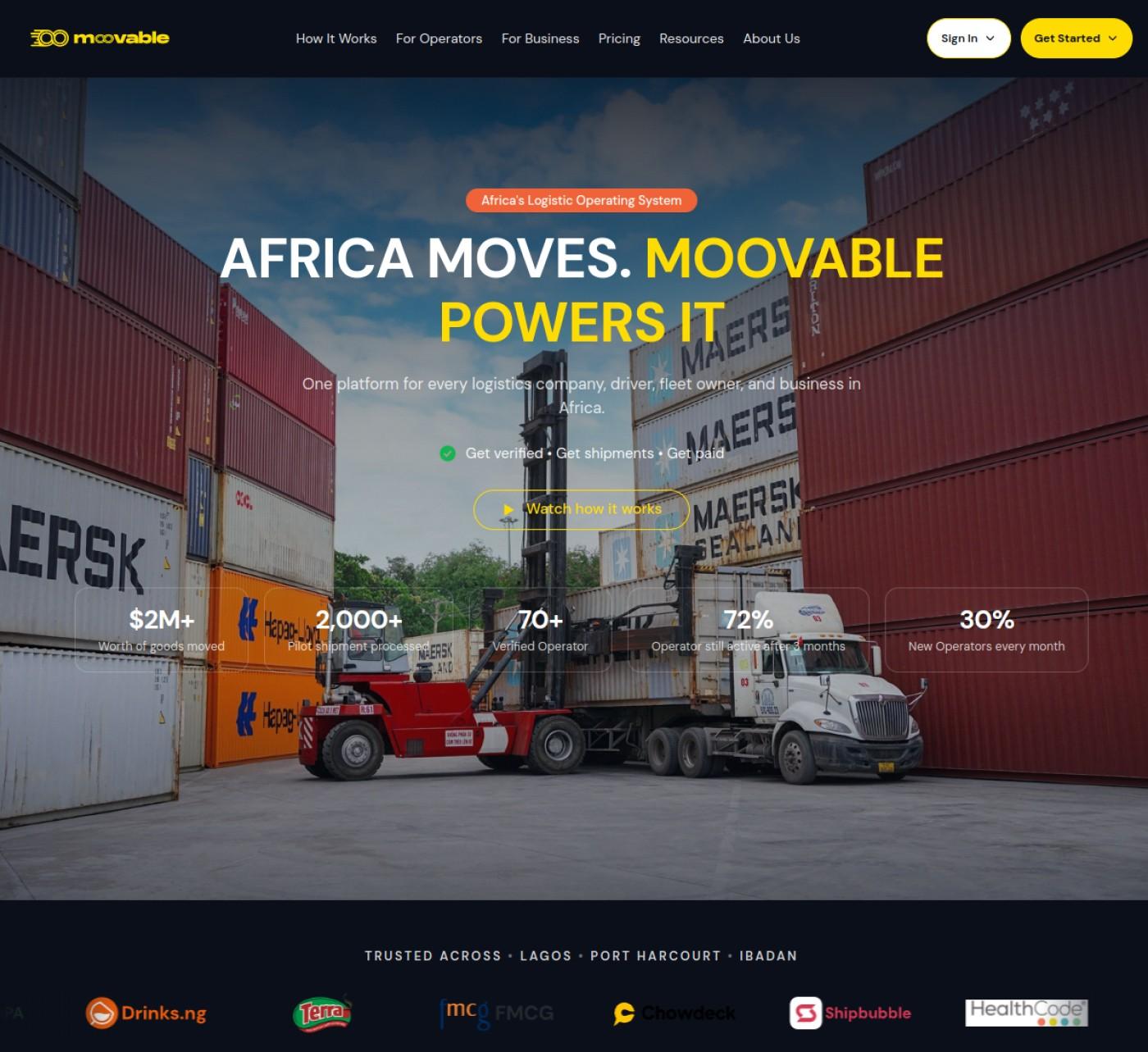
2,000+
Pilot shipments processed
Reported on Moovable’s public homepage.
70+
Verified operators
Reported on Moovable’s public homepage.
72%
Operators active after three months
Reported on Moovable’s public homepage.
Reported on Moovable’s public homepage, reviewed 26 November 2026. These are platform-level figures. Design-specific outcome measurement is separate.
Design delivery
450+ major screens and modals across three connected portals, with reusable interaction patterns and an extended design system.
Product delivery & learning
Requirements collaboration, sprint involvement, implementation reviews and early customer feedback inform continuous refinement.
Reflection
This project reinforces how important it is to understand the operations behind an interface. Each role needs a clear experience for its own responsibilities, and the connections between those experiences are just as important.
Combining product ownership and design gives me the opportunity to work across the requirements, interface decisions, technical collaboration and implementation review that turn a complex product into a coherent experience. Moovable is an ongoing project, and continued customer feedback remains part of the product’s development.
Moovable
One system, three connected experiences, built around the people who move goods across Africa.
Next step
Have a similar project in mind?
Tell me what you’re building and I’ll help you shape the next step.